Introduction
The book industry is changing faster than most aspiring authors realize. For decades, the only path to becoming a "real" author ran through literary agents, editorial boards, and publishing houses that decided often on a whim whose stories deserved to be told. That gatekeeping model made sense when printing presses were expensive and distribution required warehouses and trucks. It makes far less sense today. Now, a manuscript can go from a Word document to a live product on Amazon Kindle in a matter of weeks, not years. Platforms have democratized distribution,readers have democratized discovery, and authors finally have a real alternative to the traditional route. The only question left is: how do you do it right? This guide answers the most common questions authors ask when they're deciding between traditional and self-publishing, and walks through exactly what it takes to publish an eBook successfully from writing to marketing.
Q1: Why is traditional publishing becoming less practical for new authors?
Traditional publishing was built around scarcity limited shelf space, limited print runs, limited attention from a handful of gatekeepers. That scarcity created long, slow pipelines that don't match how readers discover and buy books today.
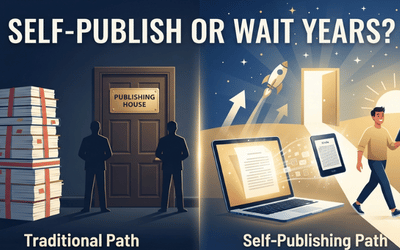
The timeline problem. A traditional deal typically involves months of querying agents, more months waiting for publisher acquisition, and then 12–24 months of production before the book actually reaches a reader. It's not unusual for the entire process, from finished manuscript to bookstore shelf, to take two to three years. For an author with a message that's relevant now, that delay can mean the moment has passed by the time the book arrives.
The royalty problem. Even after that wait, most traditional contracts pay authors somewhere in the range of 10–15% of net receipts. The publisher takes on printing and distribution costs, but it also keeps the majority of the revenue indefinitely, across the life of the book. Selfpublished authors, by contrast, typically retain 60–70% of royalties on platforms like Amazon KDP, because there's no publishing house sitting between the author and the sale.
The control problem. Traditional publishers also retain significant say over cover design, title, editing direction, and release timing. For many authors, the trade-off of "someone else prints my book" in exchange for "someone else owns key creative decisions" no longer feels worth it especially now that professional-quality self-publishing is genuinely achievable. None of this means traditional publishing is obsolete. For certain genres and career goals, it still offers advantages self-publishing can't replicate, like large advances or major retail placement. But for most new authors, the math on time and royalties has shifted decisively toward independence
Q2: Is self-publishing an eBook actually beneficial for society?
Yes and this is worth taking seriously beyond the individual author's convenience.
Self-publishing vs. traditional publishing isn't just a business decision; it's a shift in who gets to participate in the marketplace of ideas. Traditional publishing, by design, filters out the vast majority of manuscripts before a reader ever sees them. Some of that filtering serves quality control. But it also means niche topics, unconventional voices, first-time authors without industry connections, and ideas that don't fit a predictable sales category often never make it to print at all.
Self-publishing removes that bottleneck. A nurse can publish a memoir about frontline burnout. A small-business owner can publish the operational playbook they wish they'd had. A novelist writing outside currently "marketable" genres can still find their readers. None of that requires convincing a acquisitions committee that the idea will sell 20,000 copies in its first year
The result is a book market with more voices, more specialized knowledge, and more diversity of thought which benefits readers as much as authors. When someone has a story or a body of expertise worth sharing, the fastest, most direct path to an audience is usually the healthiest one for both the author and the public
Q3: What are the main steps required to successfully selfpublish a book?
Self-publishing gives you control, but that control comes with responsibility for each stage of the process. Here's the full picture of how to publish an eBook the right way:
1. Writing and editing. This is the foundation. Whether you're writing the manuscript yourself or working with a ghostwriter, the content needs structural editing (does the book flow logically?) and copyediting (is it clean, grammatically correct, and consistent?) before it goes anywhere near a retail platform. Skipping this step is the single biggest reason selfpublished books get poor reviews.
2. Book cover design. Readers absolutely do judge books by their covers especially in a Kindle store where a cover might appear as a two-inch thumbnail next to a dozen competitors. Professional book cover design services matter here: a cover needs to signal genre, quality, and tone at a glance, using typography, imagery, and color choices that align with reader expectations for that category.
3. Formatting for distribution. An eBook file needs proper formatting for Kindle, EPUB, and print-on-demand specifications. This includes front matter, table of contents, chapter breaks, and for print copies trim size, margins, and bleed settings. Formatting errors are one of the most common reasons for rejected or poorly-reviewed self-published titles.
4. Publishing and distribution. This is where a solid Amazon Kindle publishing guide becomes essential understanding KDP's royalty structures, choosing between Kindle Select exclusivity and wide distribution, setting pricing, and selecting the right categories and keywords so the book is actually discoverable.
5. Marketing. Publishing the book is not the finish line it's the starting line. A launch strategy, an author page, early reviews, and ongoing promotion determine whether a book finds readers or disappears into the millions of other titles on the platform.
6. Budgeting realistically. Self-publishing costs vary widely depending on how much you do yourself versus hire out. Editing, cover design, and formatting can run from a few hundred to a few thousand dollars depending on quality and scope, and marketing has its own ongoing costs. Understanding this upfront prevents nasty surprises mid-project.
Why choose Flink Publishing?
At Flink Publishing, we make the publishing process simple, affordable, and stressfree for authors around the world.
We provide complete end-to-end publishing services, including:
- Professional book writing and editing
- Book formatting and interior design
- Custom cover design
- ISBN guidance
- Publishing on Amazon Kindle (KDP), IngramSpark, and other major platforms
- Paperback and hardcover printing
- Book marketing and promotional support
- Author consultation throughout the publishing journey
Our goal is to help writers transform their manuscripts into professionally published books without unnecessary delays or excessive costs.
Q4: How can an author manage all these steps without getting overwhelmed?
Here's the honest answer: very few authors are equally skilled at writing, design, technical formatting, distribution strategy, and marketing. Trying to DIY every single stage is where most self-publishing projects stall out a manuscript sits half-edited, or a cover gets designed in a rush and undersells a genuinely great book
This is exactly the gap that full-service self-publishing partners exist to close. Flink Publishing, for example, works with authors across the entire journey, professional ghostwriting and editing, book cover design, print production, and marketing strategy under one roof, rather than requiring the author to separately vet and coordinate five different freelancers.
The appeal for most authors isn't just convenience, though. It's the combination of fast-track delivery (so a manuscript doesn't sit in limbo for months), transparent and reasonable pricing (so authors know their costs upfront instead of watching them balloon), and end-toend guidance at every stage, from a rough first draft to a fully marketed, published book.
The goal of a service like this isn't to replace the author's voice or vision it's the opposite. It's to remove the technical and logistical friction so the author's story reaches readers faster, without losing creative ownership along the way.
Conclusion: Your Story Deserves to Be Told Now
The old model of publishing asked authors to wait for approval, for a slot in next year's catalog, for a gatekeeper's permission to share their own ideas. Self-publishing flips that arrangement. The author keeps the creative control, keeps the majority of the earnings, and keeps the timeline in their own hands.
That said, doing it well still requires real craft at every stage: strong editing, a cover that actually sells, clean formatting, and a marketing plan that gets the book in front of readers. If managing all of that alone feels daunting, it's worth exploring self-publishing partners like Flink Publishing, who specialize in guiding authors through the entire process quickly and affordably